Investors and funds
You are considering an investment in a company whose value sits in its technology, and your investment committee wants an independent technical view.
Technical due diligence
For investors, funds and boards considering a technology company. We review the technology, the security and data, and the IP behind the product, and report the risks that matter to the investment, each with its severity and a mitigation.
Before an investment · Report · readout session
Who it is for
You are considering an investment in a company whose value sits in its technology, and your investment committee wants an independent technical view.
You need an outside read on the technology in a company you oversee, from engineers with no stake in the answer.
A rush option puts the review at the front of our queue and commits us to the short end of the turnaround.
Senior engineering judgement for one decision, without a long-term commitment.
The founders, backed by an engineering team
BMEC's founders, Raphael Smith and Heidi Wilson, carry out the reviews and lead the readout themselves. They draw on the in-house team that builds products for our clients, across software, electronics, mechanical and medical engineering.

What we review
Each review covers three areas, scaled to the size and stage of the company. Where the company makes hardware, the review also covers the electronics, firmware and manufacturing.
What the product can do, tested hands-on, and how it is built.
How the company protects its systems and its customers' data.
Who owns the code, data and models, and what the company is allowed to do with the software it uses.
What you get
The findings, the material technical, cybersecurity, data and IP risks with the severity and potential impact of each, the gaps that need remediation, mitigating actions split into before and after the investment, and the matters that need a further specialist.
We take you through the findings and answer your questions before the final report is issued.
Anything serious is reported to you as soon as we find it, without waiting for the report.
Inside the report
Both examples below are illustrative. The findings are invented and do not come from a real review.
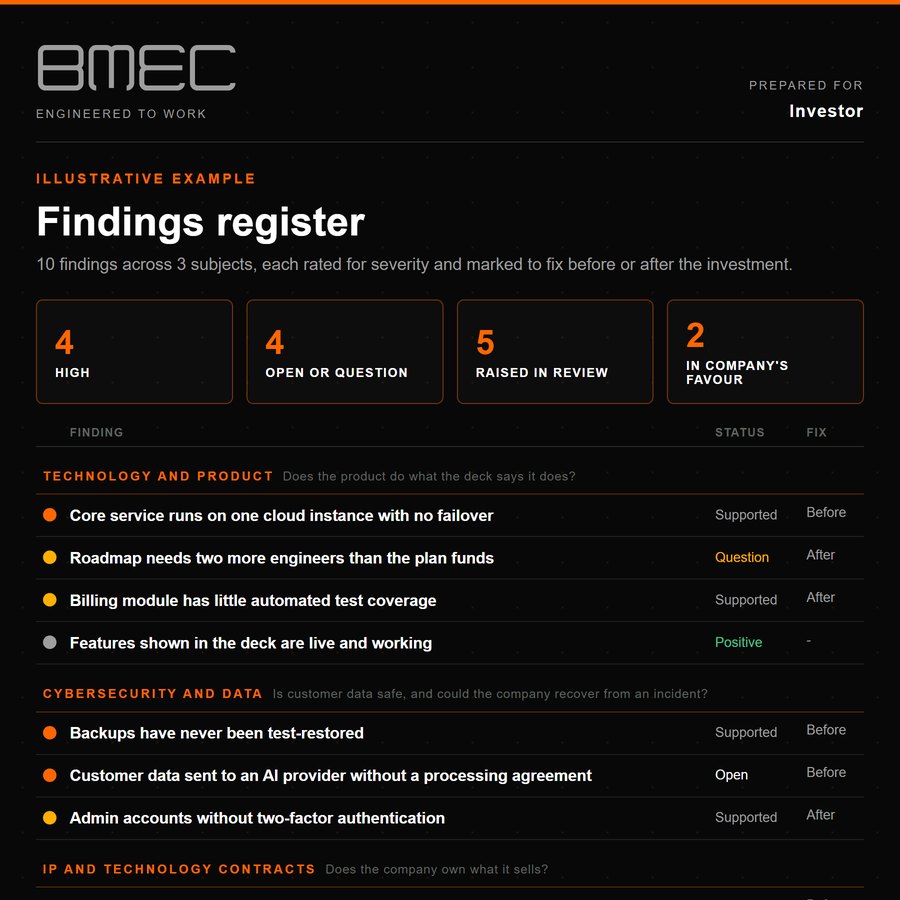
Every finding, with its evidence and status
We log each finding as the review runs, with where it came from, the evidence behind it, its severity and whether it should be fixed before or after the investment. The report is written from the register, and findings in the company's favour are recorded alongside the risks.
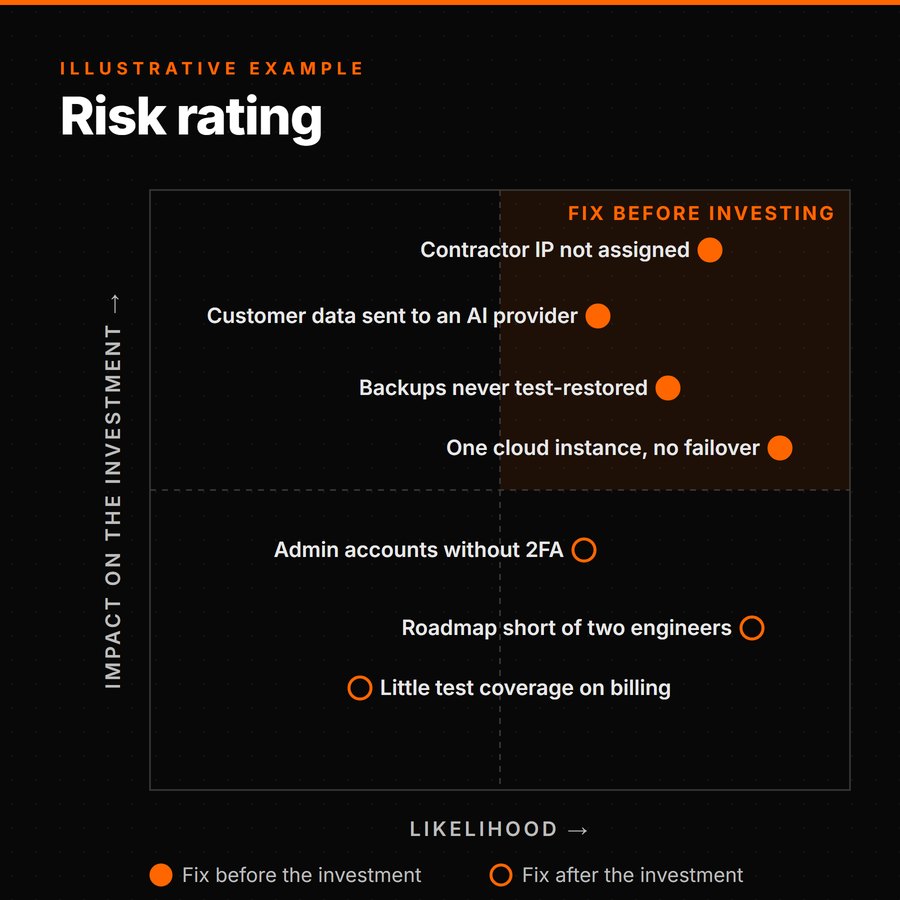
Likelihood against impact on the investment
Each risk is placed by how likely it is and how much it would change the value of the investment. Those that are both likely and costly are the ones to fix before the money moves, or to reflect in the terms.
How deep we look
All three answer one question. Is there anything in the technology, security, data or IP that should stop the investment or change its terms? They differ in how deep we look and how long the review takes, and each has a fixed scope and a fixed fee agreed before we start.
Interviews, hands-on use of the product, and a review of documents and agreements. For when time is short or code access is not possible.
Adds read-only access to the code and cloud, automated scans and an open-source licence scan.
Adds hands-on review of the core code, a cloud security scan, and a test of whether the team can deliver its roadmap.
How it works
Penetration testing, legal opinions on IP, contracts or POPIA, and financial and commercial due diligence. We give the technical view and your attorneys give the legal opinion. If a penetration test is needed, we recommend a specialist. Code is reviewed by sampling.
Where it leads
The mitigations marked after the investment become work for the company. For a company in your portfolio, a Risk Review gives the same outside view of a project before it gets expensive, and a Discovery Phase turns the work into a fixed-price plan. We also work as fractional CTO for early-stage companies.
For a project about to get expensive. An independent techno-commercial read on what could go wrong, with a recommendation against each risk and a view on whether deeper work is warranted.
Read more →The full definition exercise. Requirements, functional specification, system architecture and a development plan, ending in a fixed-price statement of work you can sign.
Read more →Start a conversation
Our founders take the first call themselves. Tell us the company, its stage and when your committee meets, and we will propose the depth that fits.